The Right to Work
The Right to Work, as reflected in the Charter of Palermo, affirms that access to dignified and fairly compensated employment is a fundamental condition for autonomy, inclusion, and the realization of broader social rights. The Charter calls for a reconfiguration of this relationship by decoupling access to work from restrictive administrative controls and by creating more stable and accessible pathways to regularization.
Numerous institutions and community associations in Palermo support people’s right to work. Labor unions like the General Congress of Italian Labor (CGIL) have run offices supporting migrants’ access to work and defense of their labor rights since the 1980s. The private service centers (Patronato CAF offices) discussed on the right to documentation page assist migrants and Italians in filling out the myriad forms and acquiring the numerous permits required to navigate the Italian labor market and access legal, unexploited employment. Members of migrant and diaspora associations also support people in their communities in seeking work and addressing workplace issues on an everyday basis. Some, like the StraVox migrant rights organization, have launched campaigns to combat wage theft, contract violations, and other workplace abuses.
Reflecting these ongoing challenges, participants in this research frequently discussed the bureaucratic hurdles to accessing legal employment as well as workplace abuses, wage theft, and discrimination in the labor market. Even for people born in Italy to parents from other countries, including in the Tamil community and others, higher education and professional credentials are often not sufficient to access the sorts of jobs for which they have trained. Work experiences among the communities that participated in this research do vary, however, with the Filipino community generally experiencing greater labor rights.
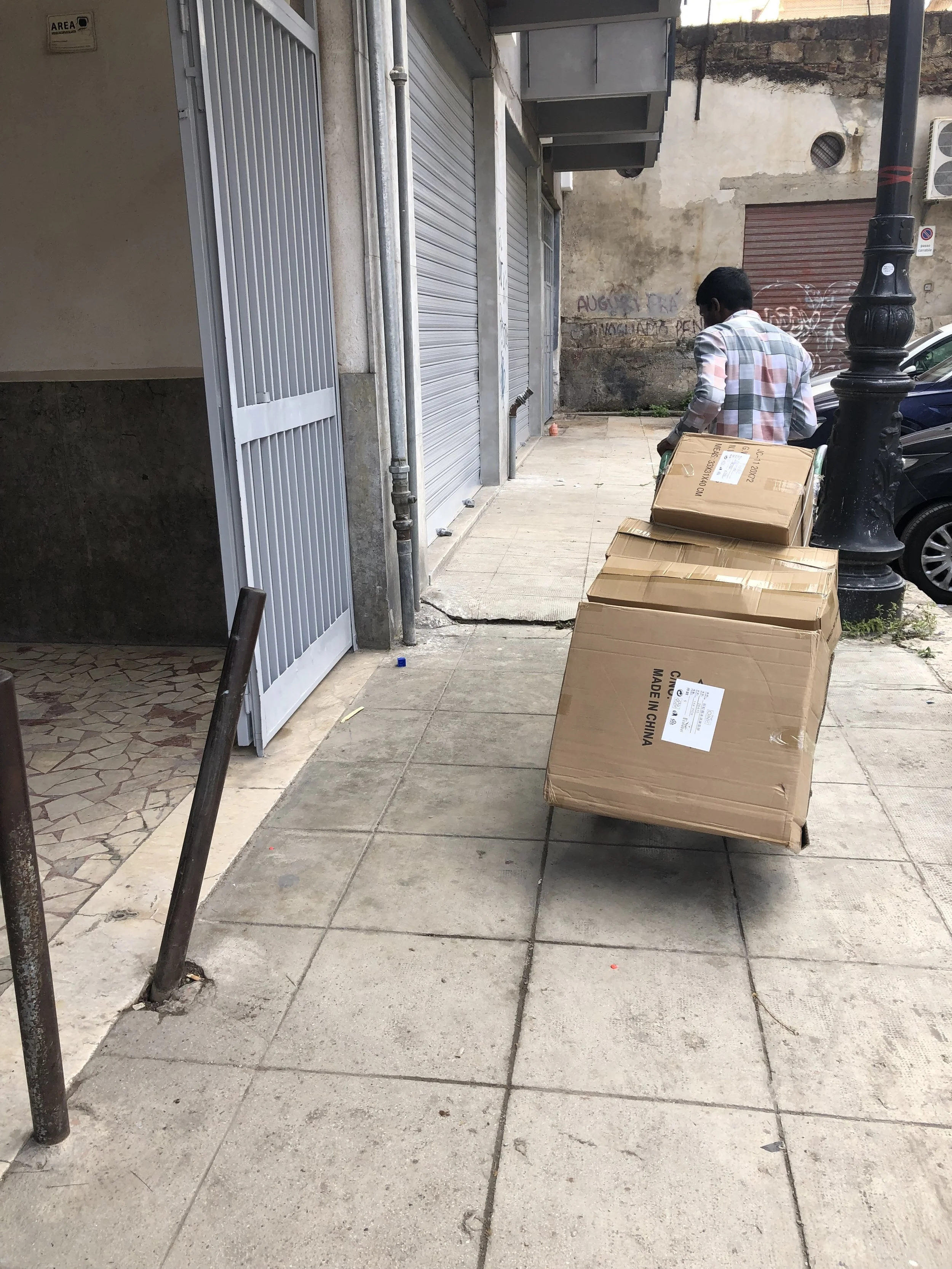
A South Asian man working in Palermo’s Chinatown.
-
“For many [Nigerians], there simply isn't work available. And obtaining official documents is another major hurdle—it’s incredibly difficult to get them. If you look at the situation—say, over the last ten years right up to the present moment—you’ll see that there aren't many Nigerians left here anymore. Most have already left; many have gone to France, many have gone to Germany. And all those people who are now in Germany—or in France—they went there and found a life that is easier than the one they were living here—a better life.”
—Member of the Nigerian Community
-
“I’ve been living here in Palermo for 14 years. I work as a merchant, though right now—for the past five years—I haven't been working; I’m at a standstill because of my residency permit situation. It’s a common issue; it’s been going on for two years now. For the moment, I’m stuck; life is hard, and work—well, work is scarce. We work just a little bit—barely enough to cover the rent, electricity bills, insurance, and gas for the car. That’s just how life is.”
—Member of the Moroccan Community
-
"Young people our age cannot access public job competitions because they usually require Italian citizenship."
—Member of the Tamil Community
-
"Our parents who perform physically demanding labor, specifically domestic work, are not granted a pension until a very advanced age."
—Member of the Tamil Community
-
"There is always a critical and very reserved eye regarding somewhat better jobs."
—Member of the Tamil Community
-
"We want to work, but we don't know where to keep our children."
—Member of the Nigerian Community
-
"I spend all day looking for a job. I am searching for work."
—Member of the Gambian Community
-
"Many immigrants struggle to find job opportunities, and even when jobs are available, the wages are often very low, making it difficult to survive."
—Member of the Ghanaian Community
-
"They don't pay well, and they don't offer proper contracts—nothing at all. It's like pouring water onto sand."
—Member of the Moroccan Community
-
"I've worked to gain this work experience, I'm quite professional, but I can't work if they don't give me the opportunity."
—Member of the North African Community
-
"For finding a job, an immigrant student needs to go through way more administrative procedures than a European. And companies don't want to bother with that. So you'll get rejected just for that reason."
—Member of the Algerian Community
-
"When you have a residence permit, perhaps you can work, you can sign an employment contract. Or your rights can be respected. When you don't have a residence permit, you don't work. Legally, of course."
—Member of the Ivorian Community