The Right to Freedom of Religion
The Right to Freedom of Religion, as reflected in the Charter of Palermo, affirms that every person must be able to hold, practice, and express their beliefs without interference, coercion, or discrimination. The document recognizes that many people on the move are fleeing violence tied to religious identity or belief. Ensuring the full realization of this right, therefore, depends on policies that safeguard both the freedom to believe and the freedom to live without fear.
Migrant and diaspora communities have created numerous spaces for worship in Palermo, from Tamil and Mauritian Hindu temples to Ghanaian evangelical churches to Bangladeshi and North African-led mosques. Many Catholic parishes have also welcomed migrants, sometimes organizing Mass in Tagalog, Tamil, or French, and sometimes appointing priests from migrant communities. Palermo’s mayor also regularly celebrates the Muslim holiday of Eid, joining an intercultural prayer at dawn usually held at a seaside park.
In a rare act of formal recognition of an Islamic community in Italy, in 1990, public authorities from the Region of Sicily and municipality of Palermo granted the nation of Tunisia a former Catholic church in the center of the city. Public religious authorities in Tunisia are formally responsible for operating the mosque, appointing the imam for what people in Palermo call the Tunisian mosque.
However, other migrant and diaspora communities lack similarly well-appointed religious spaces. Virtually all other mosques in Palermo operate in adapted garage spaces, as do most Ghanaian evangelical churches. As some participants in this research noted, Italy prohibits mosques from broadcasting the call to prayer, and the nearest cemetery where Muslims have found space to bury their dead is in Messina, on the other side of Sicily. Many Muslims and some other migrants in Palermo pay thousands of euros to send the bodies of their deceased relatives to their countries of origin for burial. Muslims who participated in this research also related their communities' experiences of more quotidian forms of discrimination.
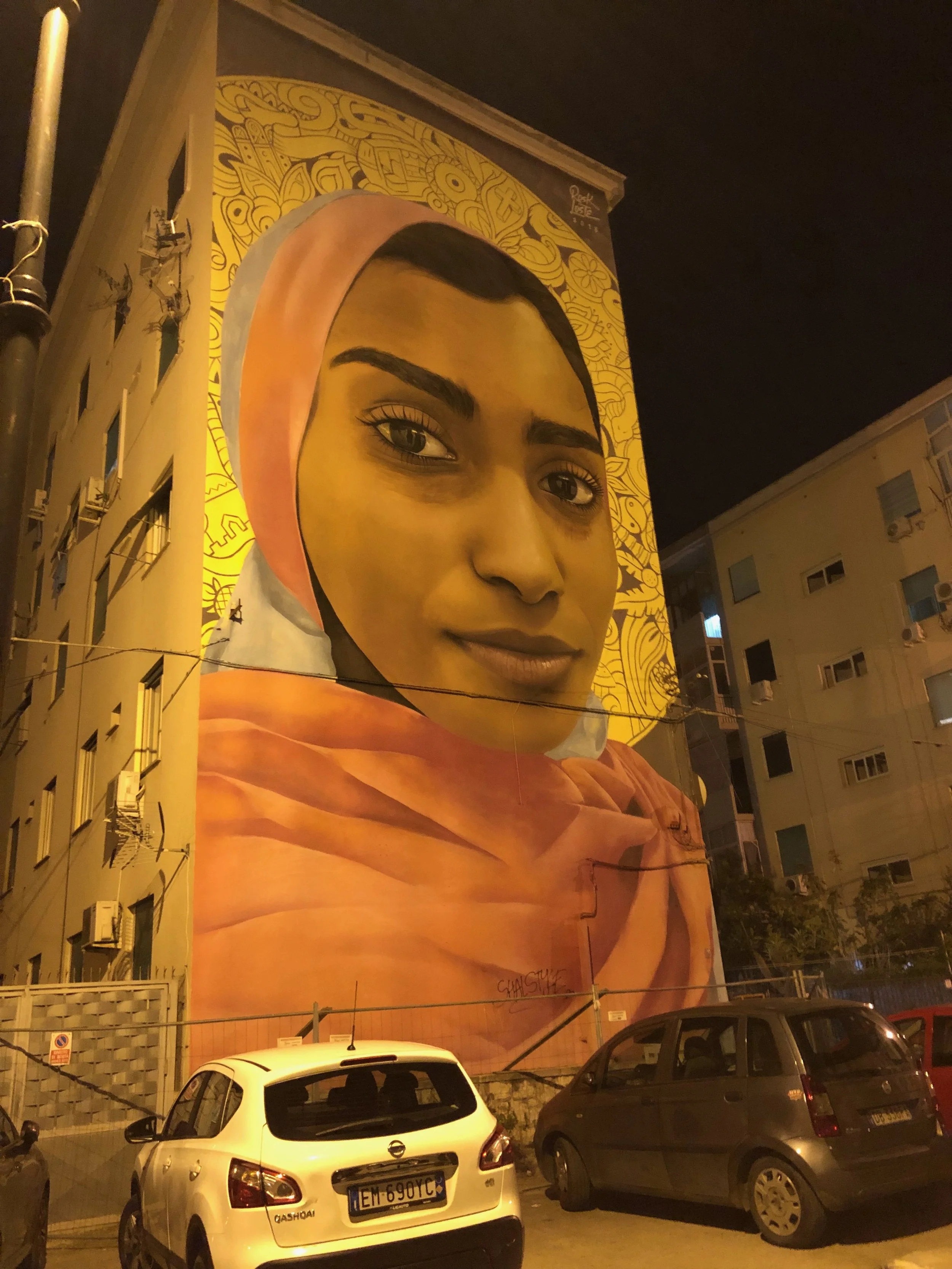
A mural of a girl in a hijab on the side of social housing in central Palermo.
-
"The situation in Palermo regarding Islamophobia unfortunately still exists, even if often it remains hidden. There are prejudices and suspicious attitudes that affect especially those who wear visible signs of their faith. At the same time however, the city is changing: many social and cultural efforts are working to promote respect and coexistence, and this gives hope that things can truly improve."
—Member of the Bangladeshi Community
-
“For Christians, each Sunday, the bells ring to call the faithful to come to church to pray. It would be right to do this also for Muslims, but for us this right is denied, to broadcast the call to prayer. And this is discrimination. I don’t know why we are denied the possibility to call people to the mosque to pray.”
—Member of the Bangladeshi Community
-
“You have the freedom and the right to express yourself… But when it comes to the recognition of Italian Islam, it doesn't exist. So on the one hand, there is the right. On the other hand, there isn't. There is the right to express yourself. Even intellectually, you can create a work, you can write a poem, you can go out and protest. You can do it very well. But we single you out. For example, if you go out and protest, you're framed differently. Especially if you're Muslim, you fall into the danger zone to some extent.”
—Member of the Moroccan Community
-
“What's the difference between me, a Muslim, and a Catholic? We meet at a table for interreligious dialogue. There's peace between us, and we collaborate and raise slogans and even do things we say locally. But why are you recognized and I'm not? Why are you a citizen and I'm not?”
—Member of the Moroccan Community
-
"I'm wearing hijab, but I don't find any problem about this. People here are very nice and they respect each other."
—Member of the Moroccan Community