The Right to Documentation
The Right to Documentation, or papers, as articulated in the Charter of Palermo, is grounded in the principle that access to legal recognition is essential to the realization of human rights. The Charter critiques bureaucratic and legal systems that delay, deny, or restrict access to documentation. It argues that these systems create artificial barriers to belonging, reinforce inequality, and undermine human dignity. The Charter calls for more inclusive and accessible pathways to legal recognition, including the regularization of undocumented individuals.
Beyond the Charter itself, the administration of Palermo Mayor Leoluca Orlando took some concrete steps to realize people’s right to papers that grant legal status and the rights that follow from it. In 2019, in opposition to the Security Decree issued by then-Interior Minister Matteo Salvini, Mayor Orlando signed over 100 migrants’ residence permits, exercising Italian mayors’ constitutional right to do so. That same year, the Orlando administration created the House of Rights, a municipal office dedicated to supporting migrants seeking legal papers and overseeing the asylum seeker shelters in the city.
Migrant-led community organizations do at least as much to support people’s access to papers, mainly the numerous documents required in Italy, but also renewal of their passports and other essential documents from their countries of origin. Members of migrant and diaspora associations, as well as migrants who run private service centers (Patronato CAFs) assisting people seeking legal papers, do this work every day, often free of charge.
More often than any other right, participants in this research project identified access to legal papers as a right they and other members of their communities were denied in Italy. Numerous participants expressed how access to all sorts of papers and rights – including to work, housing, healthcare, among many others – depends upon people having other papers, especially for legal residence.
However, since the national government’s Cutro Decree of 2023, Italy essentially puts migrants in a catch-22 in which they must have legal residence to acquire a work permit, but they must have legal work to obtain legal residence. Some people find legal pathways around this. But more broadly, Italy’s documentation regime and asylum system produce illegality, denying people the ability to legalize their residence, work, and other aspects of their lives.
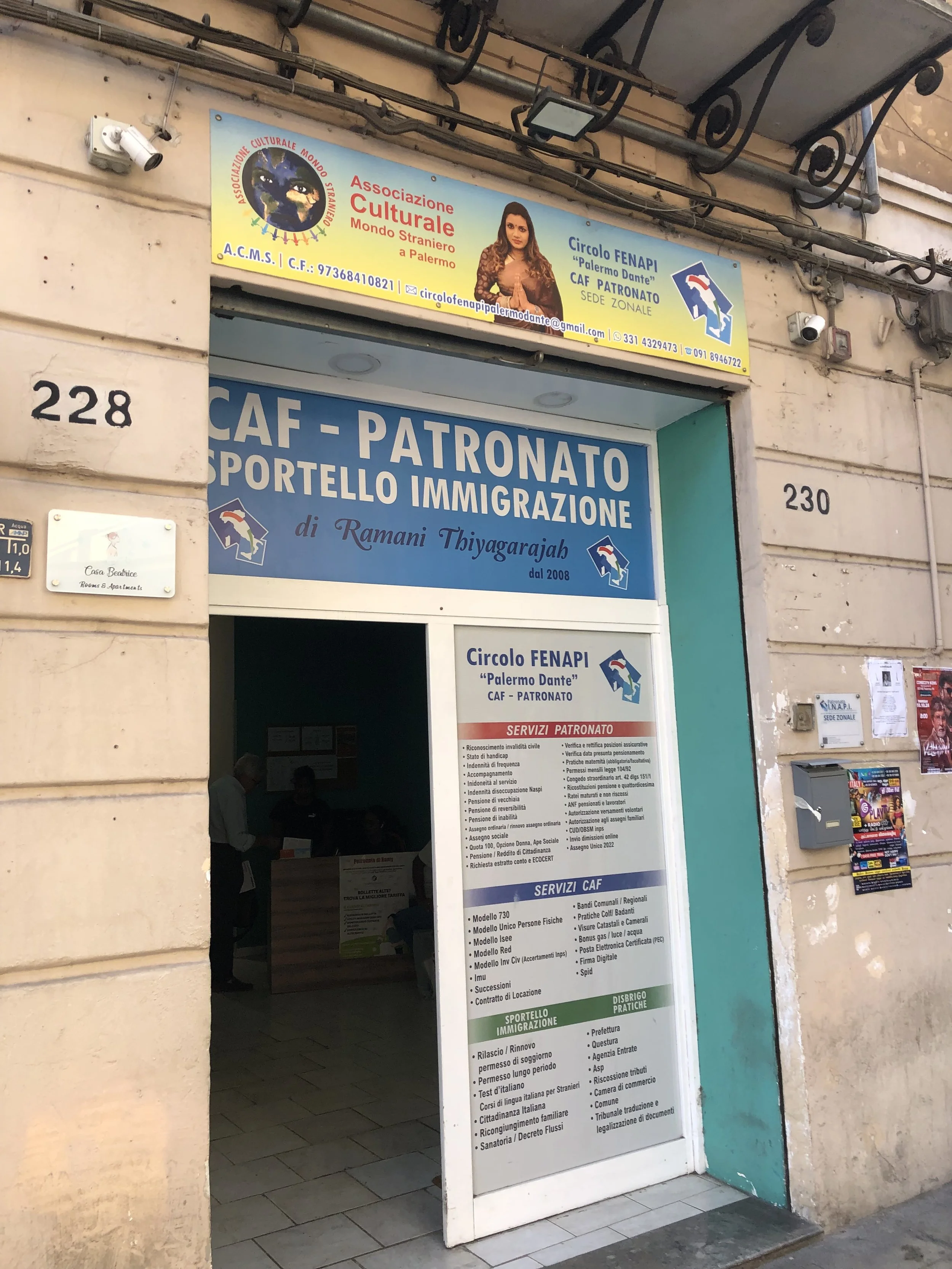
A Patronato CAF office in Palermo’s Tamil community, with a list of all the services it provides assisting people in acquiring papers.
-
"A passport... gives you all the rights: the right to healthcare, the right to education, and also the right to dream, to make plans, the right to housing. Without this document, you have nothing."
—Member of the Ivorian Community
-
"Immigrants have become pieces of paper. These human beings, created by the Lord of the Worlds, have become pieces of paper. Wherever you go, no one asks your name."
—Member of the Middle Eastern Community
-
"With residence permits, they wait a year, then another six months; then, as soon as they finally receive one, they find it has already expired so what are they supposed to do?"
—Member of the Tamil Community
-
"My problem here is, first and foremost, a paperwork issue—a problem with documents."
—Member of the Gambian Community
-
"The system can be so stressful, like documents. It's often slow and confusing."
—Member of the Ghanaian Community
-
"For someone who doesn't have documents, how is one supposed to obtain a pay slip in order to rent a home?"
—Member of the Nigerian Community
-
"When I want to do my papers...I have to speak Italian, and I don't know how."
—Member of the Moroccan Community
-
"I have a bachelor's degree and...I can't continue my studies here because when I want to apply to my master's, I can't because I need some other papers."
—Member of the Moroccan Community
-
"Without a permit you can't have work; Without work you can't have a permit."
—Member of the Moroccan Community
-
"Despite having a valid visa in Italy, I have not yet received a permit of legal residence. Many times I have to go to the Quaestura (registry office) and stand in line to obtain documents and courtesy. There exists no adequate system for foreigners. Instead, we do not know clearly what system the current government is adopting for foreigners. People talk continuously about different things, especially about not granting residence permits permanently to Bengalis."
—Member of the Bangladeshi Community
-
"I have no nationality. I have no permanent residence permit."
—Member of the Middle Eastern Community