The Right to Cultural Freedom
The Right to Cultural Freedom, as reflected in the Charter of Palermo, affirms that all people must be able to express, practice, and develop their cultural, linguistic, and religious identities without fear of exclusion or discrimination. The Charter advances a vision of the city as a space of exchange, where diverse traditions, practices, and forms of knowledge coexist and interact. The Charter calls for forms of coexistence that move beyond tolerance toward a more substantive and participatory vision of belonging.
In the 21st century, Palermo has been an important center of social movements and institutions that foster cultural expression and cross-cultural exchange among diverse individuals and communities. Much of this work simultaneously promotes human rights. Social enterprises like Moltivolti, social centers and movements like Maldusa, and numerous community organizations and festivals do this work. The Church of Santa Chiara has been especially important as a space where migrant communities hold their own gatherings, usually inviting people from other cultures to participate and often serving as events where people support one another. Much of the street art in Palermo also reflects this intersection of cultural expression and human rights.
The numerous associations in migrant and diaspora communities sustain people’s right to cultural freedom on an everyday basis. Organizations like the Bangla School, a partner in this project, and the multiple schools in the Tamil community teach young people those languages and about the history and cultural practices of their ancestors. Associations like the Union of Ivorians in Sicily (UNIS), another partner in this project, organize festivals celebrating the diverse ethnic groups from their country, inviting people from other ethnic and nationality groups, including Italians. Members of UNIS also gather weekly to cook, eat, and socialize together, sustaining bonds and cultural practices in the community. These sorts of examples are repeated across the numerous migrant and diaspora communities of Palermo.
At the same time, many people in migrant and diaspora communities continue to experience discrimination and intolerance of their cultural identities and practices. Participants in this research, especially Black people and Muslims, related various experiences of discrimination and denial of their right to cultural freedom and expression.
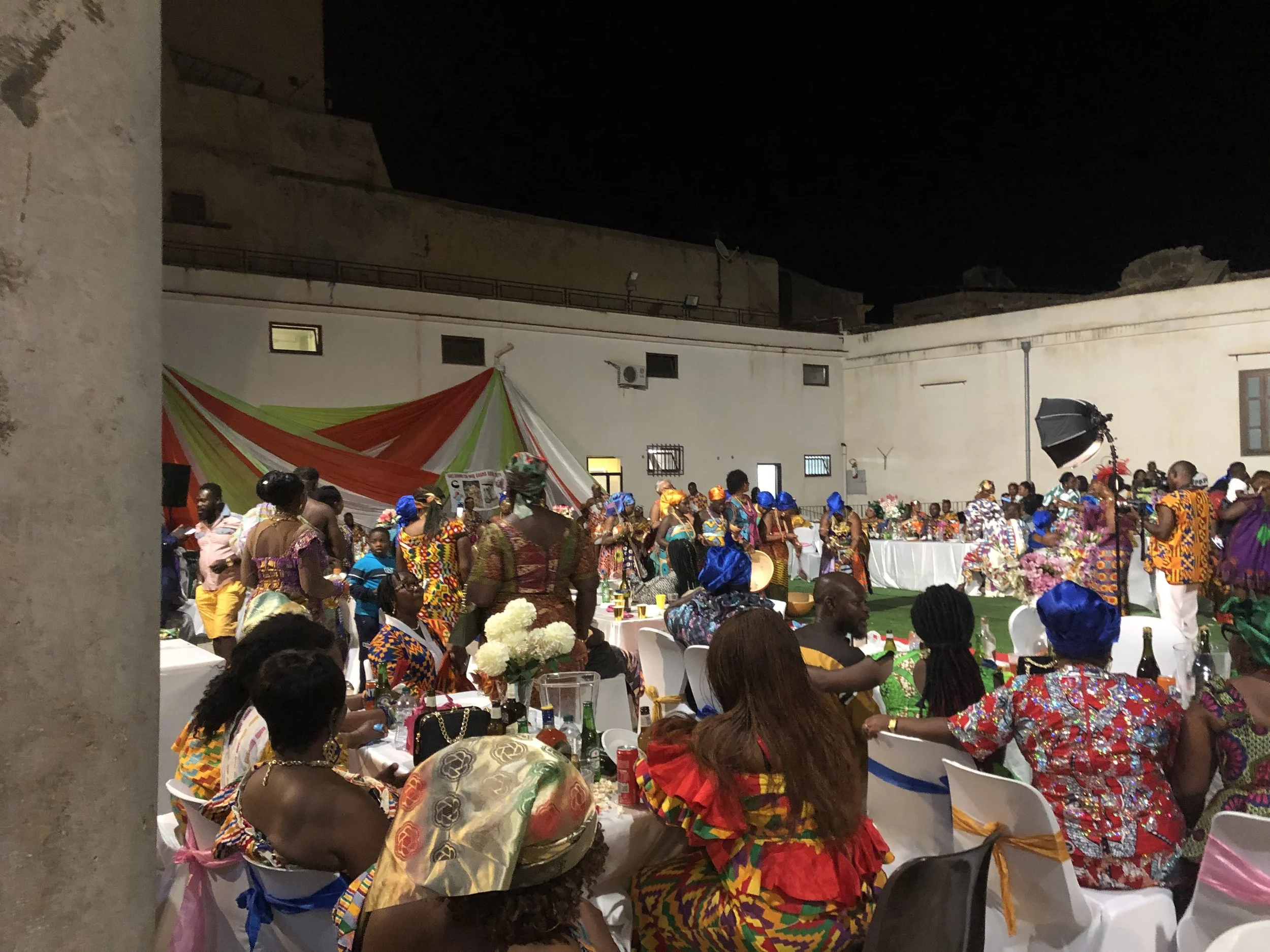
A Ghanaian festival in the “Migrants’ Courtyard” at the Church of Santa Chiara.
-
"Every young person who grows up and studies here deserves to be recognized for their true worth."
—Member of the Ghanaian Community
-
"Italians are so friendly, most of them... but some are a little ignorant... even in this modern world, 2026, there are many people who are still racist."
—Member of the Ghanaian Community
-
"Every culture has its own intrinsic value. No one should be compelled to conform to their surroundings."
—Member of the Tamil Community
-
"I feel like an Italian, but I also feel Tamil—it is my second cultural identity, but not second in importance."
—Member of the Tamil Community
-
"Respecting a person also means respecting their culture."
—Member of the North African Community
-
"The city is changing: many social and cultural efforts are working to promote respect and coexistence, and this gives hope that things can truly improve."
—Member of the Bangladeshi Community
-
"No matter how well I speak the language or how much I understand their [Italian] culture, I'm never truly seen as normal. There is always this invisible line between me and them. I may do everything right, speak like them, study like them, and even behave sometimes like them, but I'll still be reduced to that girl. It feels like my identity, how I behave, how I present myself, how I talk, and how I do everything is decided for me and not the other way around. And no matter how hard I try to change the situation, it's never enough."
—Member of the Ghanaian Community
-
"I am a Bharatanatyam dancer. After a Bharatanatyam dance show, if I went to school the next day still wearing my mardani—that is, my anklets—my classmates would immediately tease me, making gestures to mimic my dancing. To them, it was all very funny; but for me, it was deeply distressing. I felt constantly under scrutiny—as if I were being judged and mocked—and this made me feel incredibly uncomfortable. I felt intensely watched and judged. What I truly wish others would understand is that our habits, our culture, and our traditions deserve respect. There is no need to judge or laugh at things you do not understand. What matters is that people educate themselves—that they try to understand the origins of these practices and the reasons behind them—rather than resorting to mockery. Every person has the right to be themselves without feeling excluded or 'different' because of it."
—Member of the Tamil Community
-
"When it comes to the recognition of Italian Islam, it doesn't exist. So on the one hand, there is the right. On the other hand, there isn't. There is the right to express yourself. Even intellectually, you can create a work, you can write a poem, you can go out and protest. You can do it very well. But we single you out. For example, if you go out and protest, you're framed differently. Especially if you're Muslim, you fall into the danger zone to some extent."
—Member of the Moroccan Community