The Right to Shelter
The Right to Shelter, as reflected in the Charter of Palermo, affirms that access to safe and dignified housing is essential to the realization of fundamental rights and social inclusion. The Charter calls on institutions to ensure equitable housing access for all residents, regardless of immigration status, while rejecting policies that produce marginalization, exclusion, or “wars among the poor.”
Civil society organizations and city government in Palermo do important work to support migrants’ right to shelter. The Catholic order formerly led by monk Biago Conte runs two shelters for people without housing; and numerous anti-mafia and other social cooperatives operate housing for asylum seekers. The municipality of Palermo’s House of Rights oversees asylum seeker housing (welcome centers) in the city, ensuring a higher level of accountability and decent accommodations in the city, particularly compared to the Sicilian countryside, where asylum seekers have suffered in abusive and inadequate welcome centers run by organized crime and other corrupt operators.
Some participants in the photo-voice interviews for this research noted their satisfaction with their housing situations, especially in the Filipino community, whose members typically rent apartments in the working-class Borgo Vecchio neighborhood. But other participants, especially from Black and Muslim communities, reported growing challenges finding housing to rent in the gentrifying historic city center of Palermo, as landlords increasingly rent to tourists and digital nomads. Some also shared experiences of landlord abuse and racial discrimination in the rental market, as discussed on the summary findings page of this website.
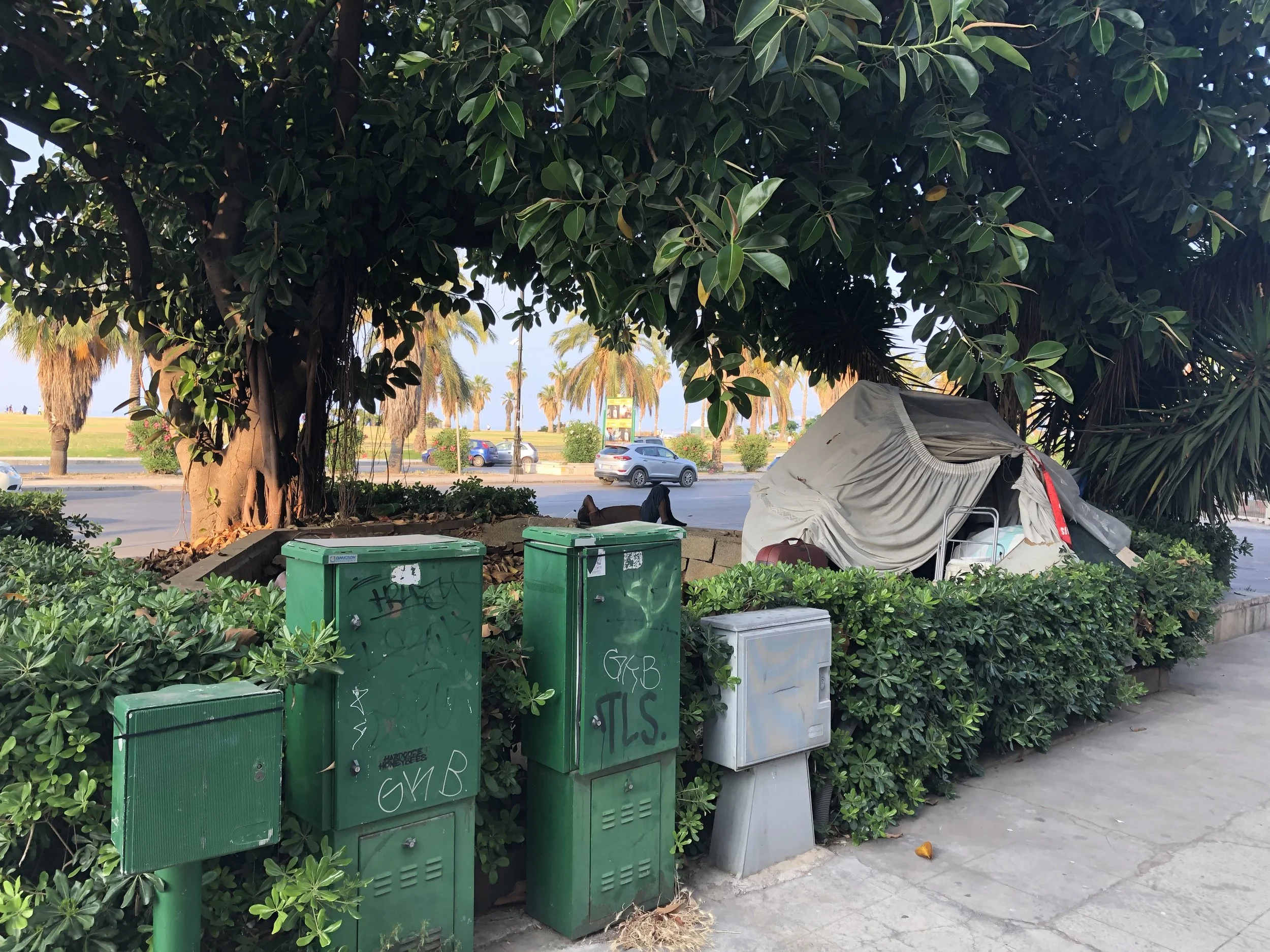
A tent under a tree along Palermo’s waterfront, in an area where people sleep on the streets.
-
“By rights realized, fortunately here in Italy some rescued people are placed in these [asylum seeker welcome] centers, where they are also given medical care, reception, integration, and, above all, help in various contexts. Some are denied access, it's always the same problem, some aren't saved because of the new laws.”
—Member of the Algerian Community
-
“First of all, what we need here as foreigners… is housing. Or those who lack proper documentation, landlords always demand papers—or, regarding one's employment status, they ask for what is known as a "pay slip." Before agreeing to rent out a home, everyone invariably asks to see a pay slip. But for someone who doesn't have documents, how is one supposed to obtain a pay slip in order to rent a home? Where are you supposed to live? Are you expected to live out on the street? How is one supposed to survive?”
—Member of the Nigerian Community
-
"A place to lay your head is mostly difficult because it's not easy for you to get a room to rent... since maybe we may be Ghanaians, but someone may not have the faith or the hope in you."
—Member of the Ghanaian Community
-
"All it takes is for a landlord to say 'no,' and everything comes to a halt."
—Member of the Ghanaian Community
-
"I have spent three years here, living on the streets."
—Member of the Gambian Community
-
"My dream is to... rent a home, [to] be independent"
—Member of the Gambian Community
-
"One of my hardest times... was the first 2 months in Palermo... [It was] very hard to find accommodation."
—Member of the Moroccan Community
-
"I can't find housing because I'm a foreigner."
—Member of the Moroccan Community
-
"Without a study permit, you can't even rent a house. And not being able to rent a house means that person has to sleep outside."
—Member of the North African Community
-
"They use all the houses for B&B."
—Member of the Nigerian Community