The Right to Freedom of Thought
The Right to Freedom of Thought, as reflected in the Charter of Palermo, affirms that every individual must be able to form, hold, and express ideas without coercion, surveillance, or constraint. Barriers such as restricted access to knowledge, linguistic exclusion, or environments shaped by fear and marginalization can limit individuals’ ability to think freely and participate fully in social life. Addressing these barriers is therefore central to ensuring that this right is meaningfully realized.
Numerous social, cultural, and educational institutions in Palermo promote freedom of thought and expression. Some are profiled on this website’s page on the Right to Cultural Freedom. Other examples include the Algerian Association for Cooperation, a partner in this project, which hosts and assists Algerian international students at the University of Palermo, arranging their housing, supplying groceries, and organizing social and cultural events that support their education and integration into city life. Algerian participants in this project expressed that these activities help them realize various rights, including freedom of thought.
Some participants in this project, however, expressed frustration with the challenges of learning Italian and realizing their right to freedom of thought and related educational, social, and economic opportunities.
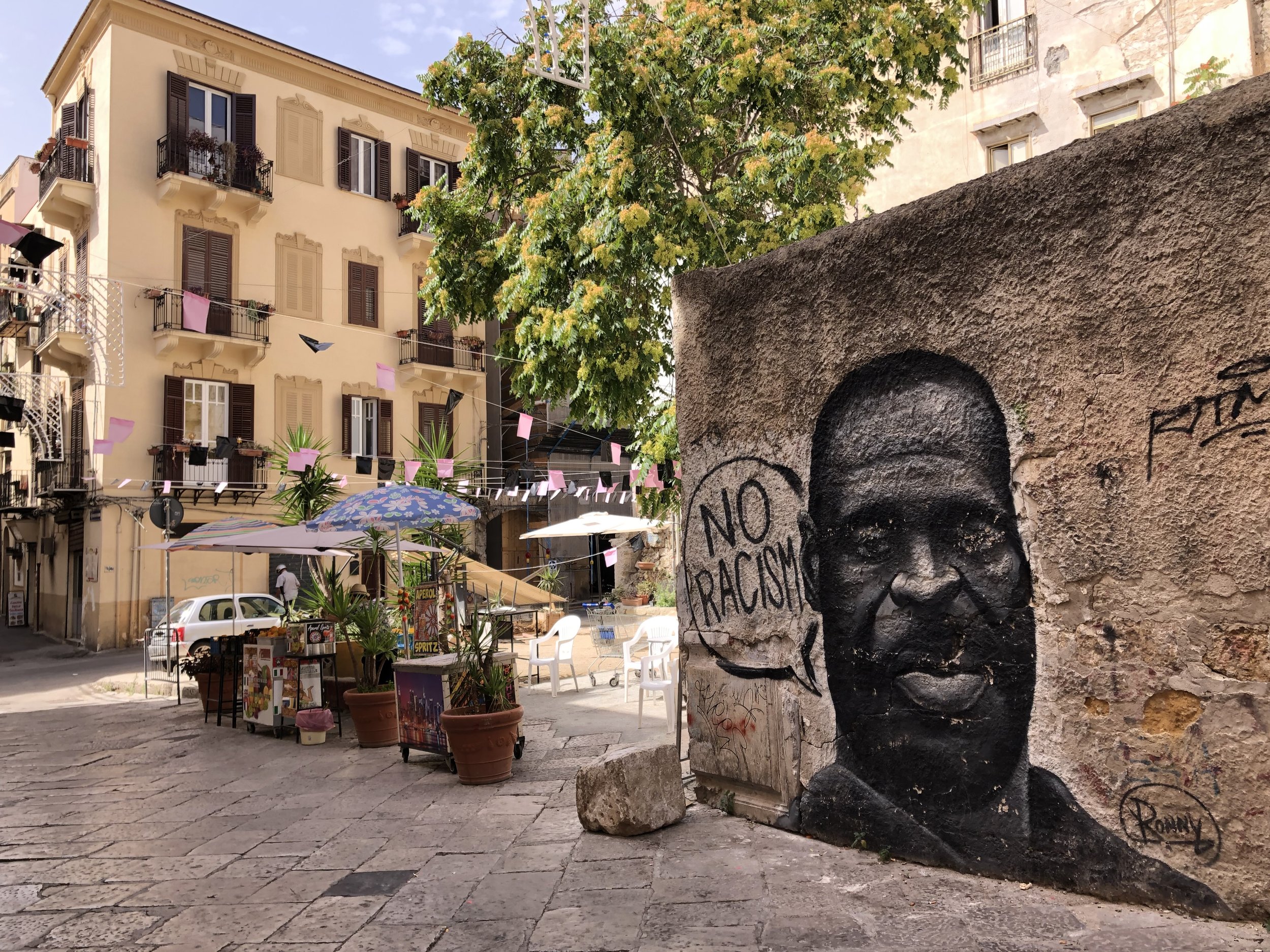
An anti-racist mural of American George Floyd in central Palermo.
-
"One of the most difficult things we literally encounter is most of the time we find it so difficult to have a conversation, to communicate. So it makes how we communicate, it's like it's slowing down communications."
—Member of the Ghanaian Community
-
“I’ve had a lot of difficulty learning Italian, and I still struggle with it—really, very much so. Because of that, I haven't been able to integrate well, as it is a very, very difficult language. I just haven't been able to master it very well. Consequently, I haven't really formed many friendships with Italian speakers, since I find it hard to connect with others.”
—Member of the Moroccan Community
-
"It feels like my identity, how I behave, how I present myself, how I talk, and how I do everything is decided for me and not the other way around."
—Member of the Ghanaian Community
-
"We can't even express ourselves in some situations. Sometimes when someone wronged you... you can't even tell the person how you feel because... you don't have the words, you don't have the language."
—Member of the Ghanaian Community
-
"Everyone should be free to express themselves as they wish—free to wear whatever they choose, and free to behave in a manner that feels authentic to them."
—Member of the Tamil Community
-
"There is the right to express yourself. Even intellectually, you can create a work, you can write a poem, you can go out and protest. You can do it very well. But we single you out."
—Member of the Moroccan Community
-
"Our voice is very important. If you don't speak out, nobody will know your situation."
—Member of the Nigerian Community